What’s the difference between a carbon credit and a carbon allowance?
Quite a lot, as it happens. Here’s an easy explainer to help understand the core differences between these important assets. Carbon credits, carbon offsets, carbon allowances, carbon permits. The carbon market is full of jargon, and not widely understood by many. What do these terms actually refer to?
Let’s look at the really important similarities and differences.

Carbon credits
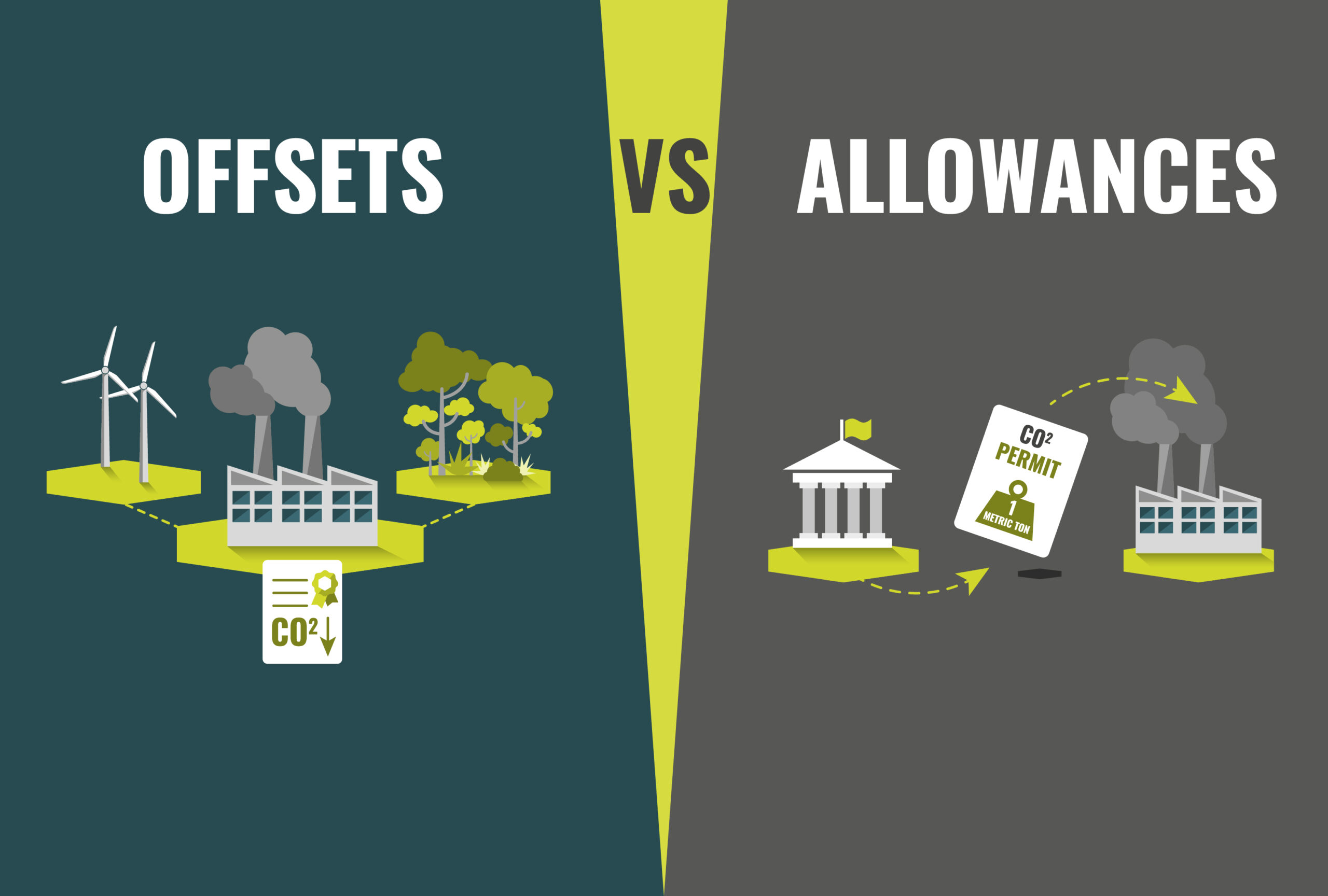
A carbon credit is a tradable unit representing one metric ton of CO2 equivalent greenhouse gas (GHG) emissions reduced, or removed from the atmosphere.
Importantly, these credits come from an international voluntary carbon market, which has grown through collaboration between companies, private carbon standards agencies and other stakeholders.
The voluntary carbon market allows those organisations to offset emissions instead of- or in addition to- reducing their own direct emissions.
The key tenet of carbon credits is that they allow an organisation to cut emissions more cheaply than would be the case if they focused exclusively on reducing their own emissions.
Examples of carbon reduction projects include planting forests, changing to cleaner fuels at an industrial plant, replacing fossil fuel-powered energy with renewables, or adopting cleaner low-emissions vehicles.
Carbon allowances
A carbon allowance, on the other hand, is a very different beast. Like carbon credits, each carbon allowance represents one metric ton of CO2 equivalent GHG gas.
However, carbon allowances – sometimes called carbon permits – are the common currency of government-led carbon compliance markets such as the EU Emissions Trading System or the US Regional Greenhouse Gas Initiative.
Emissions trading systems work by setting an absolute limit on the CO2 that can be emitted each year. Companies need to compete in a market place to buy certificates that represent legal permission to emit GHGs, or face stiff financial penalties.
Carbon allowances under these so-called cap-and-trade systems tend to have a fixed supply which reduces each year. For every ton of CO2 emitted, companies must hand over one allowance to the body regulating the program.
As the supply slowly tightens, making them scarce, prices of permits rise, creating a financial incentive for companies to either reduce their own emissions and sell the resulting surplus allowances to someone else, or buy enough to cover their own needs.
The result is that emissions reductions tend to happen where the cost is lowest, ensuring maximum economic efficiency, while guaranteeing that the overall volume of carbon emitted falls according to a pre-determined trajectory underpinned in the legislation.
Summary
So there you have it: carbon credits come from projects that reduce emissions compared to a business-as-usual baseline, while carbon allowances are a legal certificate that allows a company to emit CO2.
In some instances, cap-and-trade markets allow the use of a limited number of carbon credits to keep costs down, and some countries that use carbon taxes allow the use of carbon credits up to certain limits, also to help companies reduce the cost of compliance.
Both carbon credits and carbon allowances form key parts of the international carbon markets and represent tradable assets that can help achieve a global goal of net zero GHG emissions in an economically efficient way.