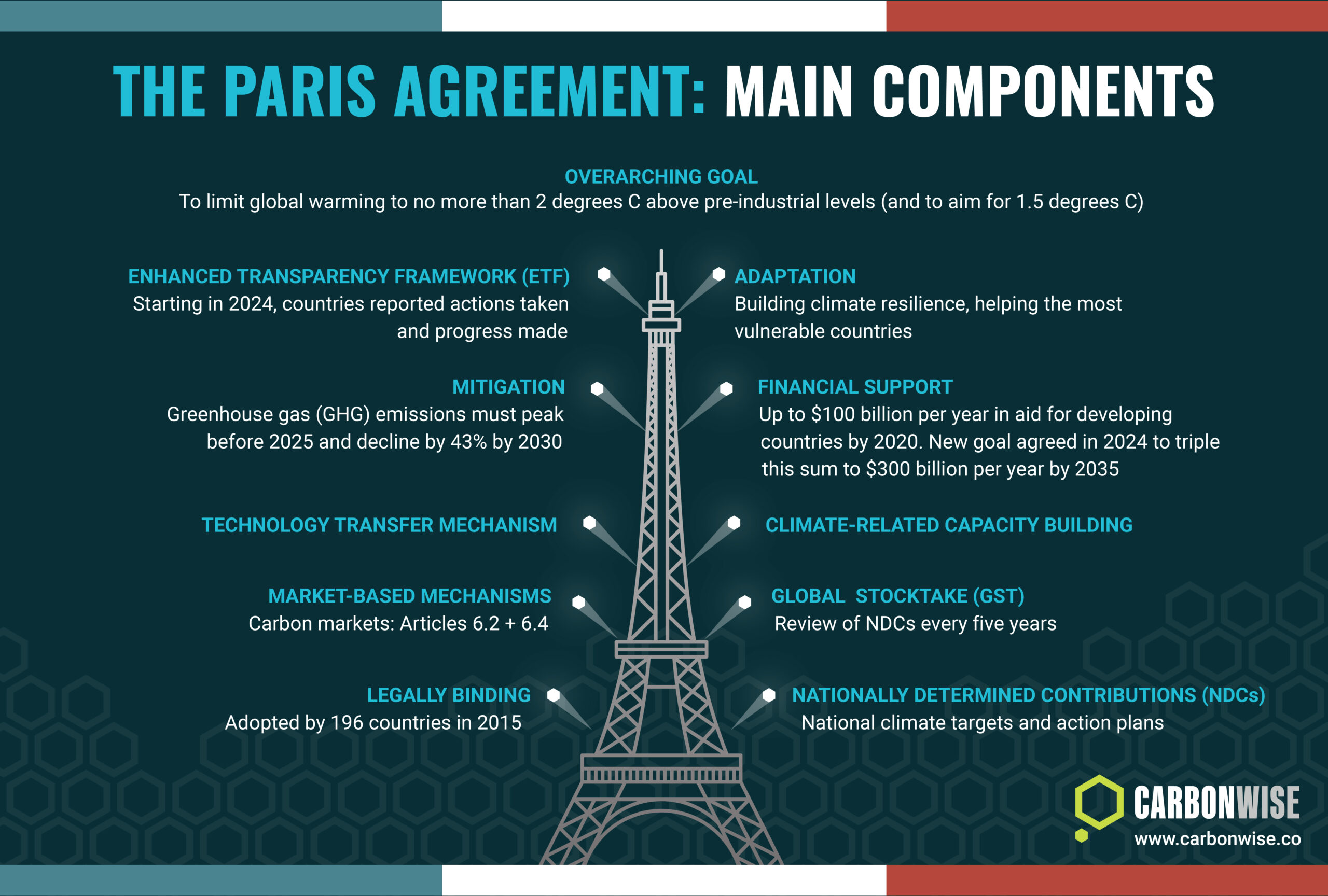
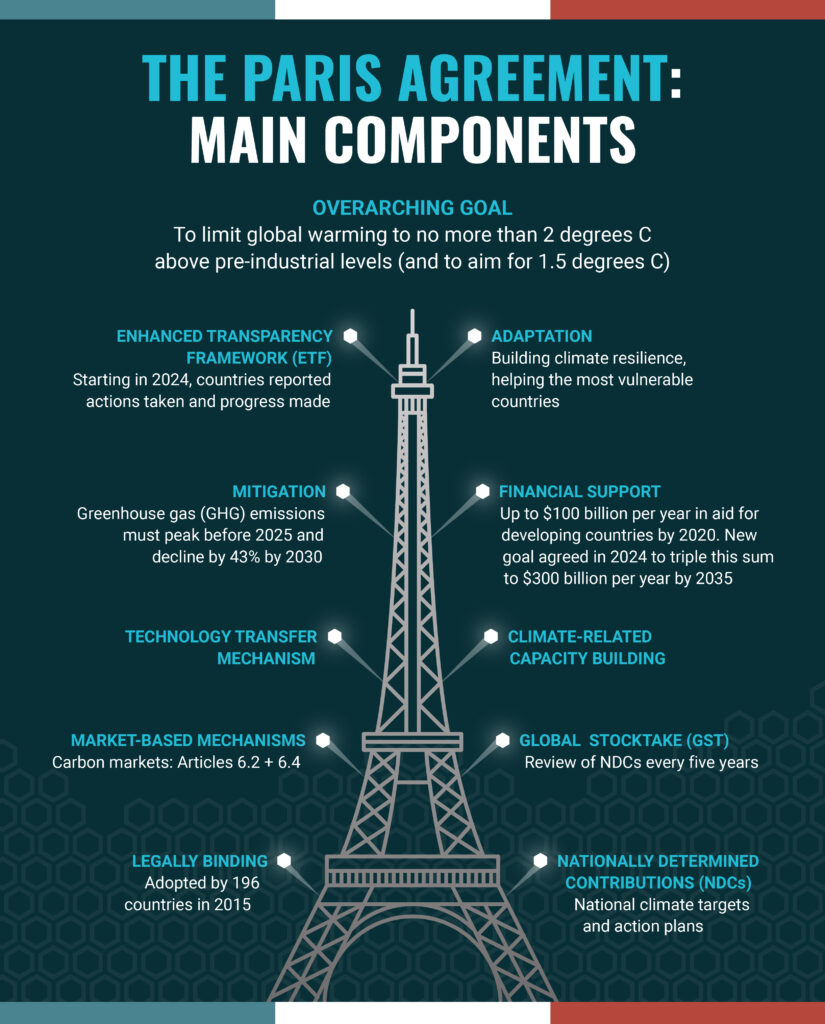
The Paris Agreement: Main Components

The Paris Agreement is not yet sufficient to address the threat of climate change, and global greenhouse gas emissions continue to increase, threatening more severe and disruptive weather including storms, flooding, heatwaves and droughts. However, the strength of the treaty lies in its inclusiveness, its repeating cycle of increasing ambition, its ability to channel finance to sustainable development and its flexible mechanisms that encourage innovation that will help to power the global clean energy transition.

Content up-to-date at time of publication

Climate Policy Compliance Market

DATA COMPILED BY

The Carbonwise editorial team is formed of seasoned established industry writers and specialist journalists.

LATEST VISUAL LEARNING

This chart shows the total amount of man-made emissions created by the world's biggest polluters.
The amount of atmospheric CO2 has charted a steady climb higher. The Mauna Loa Observatory on the north flank of volcano of the same name
CO2 emissions from the industrial sectors led to a year-on-year drop in 2025 under the EU Emissions Trading System, according to verified European Commission figures
Refers to sectors in which greenhouse gas emissions are difficult to reduce. Includes industries such as iron and steel, cement, refining, chemicals, shipping, aviation and
A set of 10 principles put forward by the Integrity Council for the Voluntary Carbon Market (ICVCM) which define high-quality carbon credits, focused on aspects

22 May 2026

HIGHLIGHT
Construction slowdown a factor in lower EU ETS CO2 emissions in 2025: EC

CO2 emissions from the industrial sectors led to a year-on-year drop in 2025 under the EU Emissions Trading System, according to verified European Commission figures released in April.

19 May 2026

GLOSSARY
Hard-to-abate

Refers to sectors in which greenhouse gas emissions are difficult to reduce. Includes industries such as iron and steel, cement, refining, chemicals, shipping, aviation and heavy duty trucks.

12 May 2026

GLOSSARY
Core Carbon Principles

A set of 10 principles put forward by the Integrity Council for the Voluntary Carbon Market (ICVCM) which define high-quality carbon credits, focused on aspects such as governance, tracking, verifiability and additionality.

Work with us

Partner with the Carbonwise team to produce innovative educational content on Carbon Markets

Work with us

Partner with the Carbonwise team to produce innovative educational content on Carbon Markets.

Sign up to our monthly newsletter for the latest content releases, events, training offers & more!​

Join the Carbonwise community