Externalities

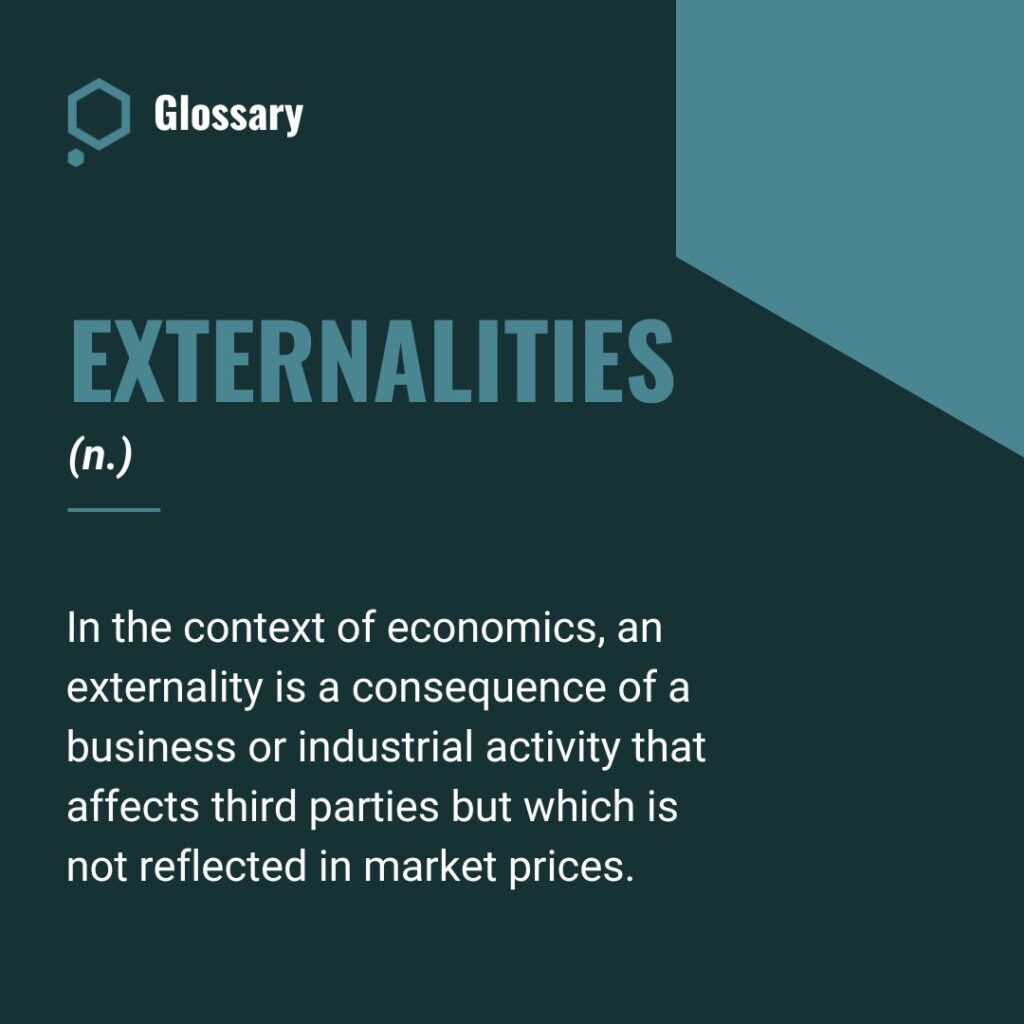
In the context of economics, an externality is a consequence of a business or industrial activity that affects third parties but which is not reflected in market prices. A ‘negative externality’ is when those consequences cause harm, for example the damage caused by a changing climate, driven by the CO2 released from the combustion of fossil fuels, or the damage to human health caused by local air pollutants released from combustion processes.

Content up-to-date at time of publication

DEFINITION BY

The Carbonwise editorial team is formed of seasoned established industry writers and specialist journalists.

LATEST GLOSSARY

Airbnb’s direct greenhouse gas (GHG) emissions come from its own offices, while indirect emissions come from the energy it consumes, and from upstream and downstream
Carbon Capture, Utilisation and Storage (CCUS) is a method of reducing carbon dioxide emissions by trapping the gas for industrial use or permanent storage, preventing
CO2 emissions from the industrial sectors led to a year-on-year drop in 2025 under the EU Emissions Trading System, according to verified European Commission figures
Refers to sectors in which greenhouse gas emissions are difficult to reduce. Includes industries such as iron and steel, cement, refining, chemicals, shipping, aviation and
A set of 10 principles put forward by the Integrity Council for the Voluntary Carbon Market (ICVCM) which define high-quality carbon credits, focused on aspects

22 May 2026

HIGHLIGHT
Construction slowdown a factor in lower EU ETS CO2 emissions in 2025: EC

CO2 emissions from the industrial sectors led to a year-on-year drop in 2025 under the EU Emissions Trading System, according to verified European Commission figures released in April.

19 May 2026

GLOSSARY
Hard-to-abate

Refers to sectors in which greenhouse gas emissions are difficult to reduce. Includes industries such as iron and steel, cement, refining, chemicals, shipping, aviation and heavy duty trucks.

12 May 2026

GLOSSARY
Core Carbon Principles

A set of 10 principles put forward by the Integrity Council for the Voluntary Carbon Market (ICVCM) which define high-quality carbon credits, focused on aspects such as governance, tracking, verifiability and additionality.

Work with us

Partner with the Carbonwise team to produce innovative educational content on Carbon Markets

Work with us

Partner with the Carbonwise team to produce innovative educational content on Carbon Markets.

Sign up to our monthly newsletter for the latest content releases, events, training offers & more!​

Join the Carbonwise community