Carbon Capture, Utilisation and Storage (CCUS) is a method of reducing carbon dioxide emissions by trapping the gas for industrial use or permanent storage, preventing its release into the atmosphere.
CCUS is widely regarded as an important tool in the broader effort to limit CO₂ emissions and address the severe impacts of climate change. Its ability to help decarbonise ‘hard-to-abate’ sectors such as metals and cement production makes it particularly valuable.
Reducing these emissions will become increasingly important as the urgency to reach global net-zero emissions around mid-century intensifies. This objective is grounded in climate science and is also reflected in the long-term goals set out in the 2015 Paris Agreement on climate change, adopted by nearly all countries. With this context in mind, it is useful to examine the different types of CCUS strategies currently available.
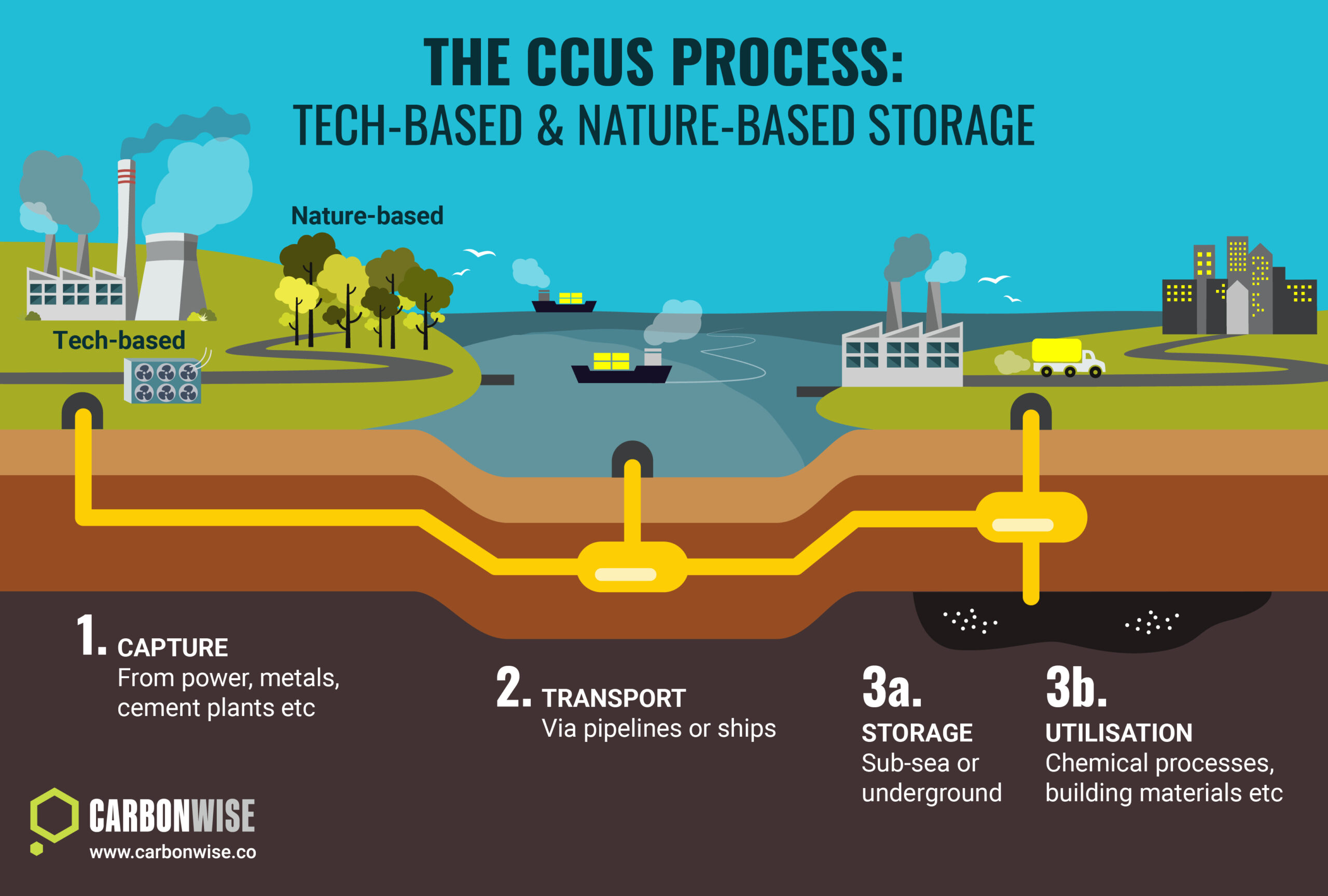
CCUS can be broadly split into two categories: technology-based, which uses engineered processes to capture and store CO₂, and nature-based, which rely on natural systems to remove and store CO₂ from the atmosphere.
When people think of a CCUS plant, they usually picture a large, carbon-intensive facility like a coal-fired power plant or a metals or cement production facility. To fit such a plant with CCUS, technology can be deployed to capture CO₂ emitted from the combustion of a carbon-intensive fuel, such as coal. This can include the use of chemical ‘scrubbers’, which chemically remove the CO₂ emissions from the waste gas, allowing it to be separated.
A partnership between technology and geology
After capture, the CO₂ can be transported and stored, for example, by compression and injection into a pipeline, which delivers the gas to a disused gas reservoir, a saline aquifer, or a similar offshore geological site for permanent storage. These natural geological structures typically consist of a gas-permeable layer that can store CO₂, beneath an impermeable caprock that traps the gas. Such sites offer significant potential for CO₂ storage to reduce atmospheric concentrations and help slow climate change.
However, nature-based solutions can play a similar role, with the main difference being that they remove rather than reduce CO₂. For example, replanting deforested or previously unforested areas can remove CO₂ from the atmosphere as the plants grow. Other examples of nature-based carbon capture include ocean-based plants and actions that increase soil-based CO₂ storage.
Various sub-categories of CCUS also exist. For example, Direct Air Carbon Capture and Storage (DACCS) uses engineered systems to filter CO₂ directly from ambient air, then permanently store it. Bioenergy with Carbon Capture and Storage (BECCS) involves using biomass that is converted to fuel and burned to produce energy, with the resulting CO₂ captured and stored. If done properly, BECCS can be carbon-negative because the plants used to produce the fuel remove CO₂ from the atmosphere as they grow.
Decarbonising the ‘hard-to-abate’ sectors
A key reason CCUS receives attention is that much of the world’s energy system remains dependent on fossil fuels such as coal and natural gas. While renewable energy sources continue to expand worldwide, they are unlikely to fully displace fossil fuels in time to meet the net-zero goal by 2050. For this reason, reaching net zero emissions will also require deep decarbonisation of the energy and industrial sectors, including legacy fossil-fuel-based power generation. CCUS is viewed as a way to reduce emissions from facilities that may continue operating for decades.
One of the often-overlooked aspects of the energy transition is that global energy demand is expected to continue growing, putting pressure on all energy sources to expand.
The Paris-based International Energy Agency has spelled out the importance of carbon-intensive fuels for electricity generation:
“Power plants fuelled by coal and gas continue to dominate the global electricity sector – they account for almost two-thirds of power generation, a share that has remained relatively unchanged since 2000 despite the advent of low-cost variable renewable sources.”
In absolute terms, power generated from fossil fuels has increased by 70% since 2000, reflecting the steady rise in global power demand more broadly, the IEA said.
Coal accounts for 38% of global power generation, followed by natural gas at about 20%, it said. Large, fast-growing economies like China and India rely on coal for more than 60% of their power generation, the agency said.
These sources of energy will need carbon capture systems in place if they are to continue playing a role in a low-carbon economy.
Governments are turning to CCUS
Meanwhile, international think-tank the Global CCS Institute says carbon capture is moving up the political agenda as pressure grows on governments to deploy viable decarbonisation plans.
“Carbon capture and storage is gaining a firmer place in the climate strategies of more governments that see few options left,” the institute said in a 2025 report.
Major economies like Australia, China, the EU, India, and Saudi Arabia see significant opportunities to embed carbon management technologies into their national climate strategies, it said.
Other notable examples include:
- Brazil: home to the largest CCS project in the world; Petrobras reinjected 14.2 million tonnes of CO₂ in 2024 for enhanced oil recovery
- Canada: committed over CAD$9 billion to CCS by 2030
- Botswana: integrated CCS into its power sector plans
- Switzerland: committed to capture and store 13-14 million tonnes of CO₂ from hard-to-abate sectors
- Uruguay: targeting CCS deployment in the cement sector
- UK: pledging £21.7 billion over 25 years to support CCUS + hydrogen
Advantages and disadvantages of CCUS
CCUS can be effective in trapping carbon emissions at scale, using known technology, and can extend the life of carbon-intensive energy or industrial facilities without the need for radical new technology.
However, CCUS also has its limitations. For a start, the technology is not commercially viable in most locations because it substantially increases facility operating costs and creates logistical and engineering challenges.
In many cases, companies are unwilling to incur the substantial costs of deploying CCUS unless there are compelling commercial reasons to do so. It tends to work only when a number of conditions are present: either because CO₂ can be used to enhance oil or gas recovery, sold for industrial use, or stored nearby.
A further factor that can support CCUS is when local or national climate or energy policies make the technology cheaper per tonne than emitting the CO₂ into the atmosphere, for example, in countries with a high carbon price. You can read more about compliance carbon markets here: How Do Compliance Carbon Markets Work? – Carbonwise.
For its part, nature-based storage can offer a simpler, cheaper, and less engineering-intensive solution for capturing CO₂, but questions remain about the permanence of using forests and other biomass to store CO₂. Other limitations include competition from other land uses such as farming, food crops, and other agricultural uses.
One part of a bigger puzzle
Carbon capture is not a panacea for greenhouse gas emissions. It can be a solution, but only in very specific circumstances. However, as the urgency to reduce emissions grows, some governments are likely to adopt policies that support CCUS projects, making it more likely that the technology will continue to expand globally.
Carbon markets are proliferating worldwide, and regulations are tightening as the urgency to cut greenhouse gas emissions intensifies. Understanding how this can impact technologies like CCUS can be helpful to companies actively charting a route to a low-carbon future.
Companies that understand the implications of environmental markets can develop a competitive edge by managing the threats and maximising the opportunities presented by carbon pricing systems.ystems.